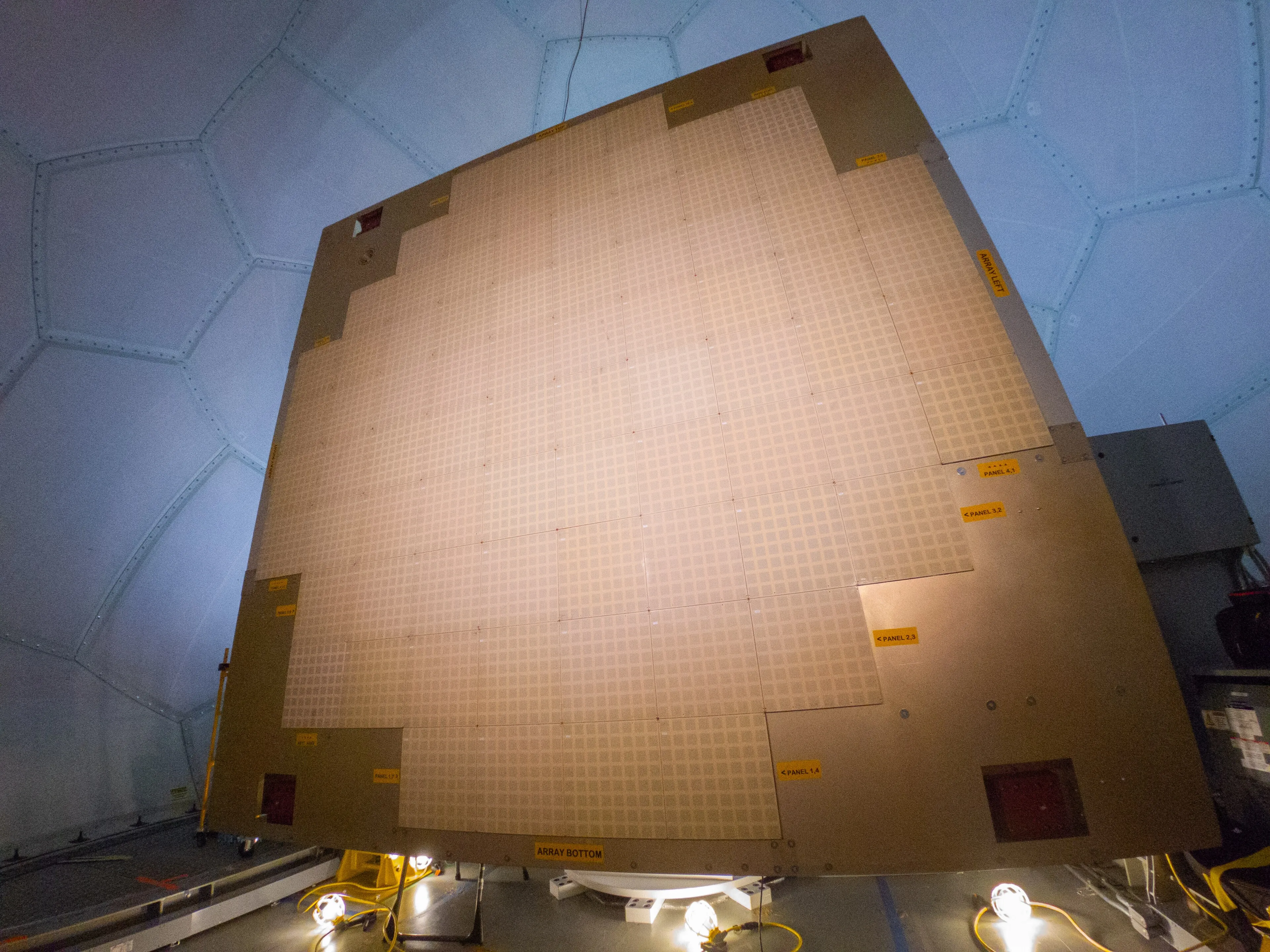
 Illustration: a NOAA phased array weather radar. Not SWR-01 hardware.
SWR-01 experimental radar
A compact radar research platform that detects objects, estimates their distance, speed and direction, and presents the result through its own software. SWR-01 is the first engineering programme of SafeWorld Industries and is designed as a civilian experimental sensing platform.
SWR-01 is a concept. No prototype has been built and no performance has been measured. The parameters below are proposals from early concept work and may change once requirements are written.
Proposed specification
Each line carries its own status. Proposed means chosen in concept work but not tested.Target means a capability the system should reach. Open means not yet decided.
| Parameter | Proposal | Status |
|---|---|---|
| Radar type | FMCW (frequency-modulated continuous wave) | Proposed |
| Frequency band | 60 to 64 GHz | Proposed |
| Antenna | MIMO array; configuration depends on the hardware selected | Open |
| Outputs | Range, radial velocity, angle, point cloud | Target |
| Processing | Range and Doppler FFT, CFAR detection, angle estimation, clustering, tracking | Proposed |
| Software | Data acquisition, real-time visualisation, interface for external software | Proposed |
| Detection range, accuracy, update rate | To be set in the requirements document | Open |
| Hardware | Commercially available 60 GHz radar development modules are being considered; none selected | Open |
Signal processing chain
The proposed processing chain follows the standard approach for FMCW radar. The first two stages are hardware; the remaining six are software, which is where SafeWorld’s existing experience applies most directly.
- 1RF front endFMCW transmit and receive, MIMO antenna array
- 2ADC captureSampled beat signal per chirp and channel
- 3Range FFTBeat frequency to distance
- 4Doppler FFTPhase change across chirps to radial velocity
- 5CFAR detectionAdaptive threshold against local noise
- 6Angle estimationPhase across virtual array elements
- 7Clustering and trackingPoint cloud to objects over time
- 8Visualisation and APILive display and external integration
What physics sets in advance
Some limits follow from the band alone, before any hardware exists:
- Wavelength at 60 GHz is about 5 mm, which allows a compact antenna array.
- A 4 GHz sweep gives a theoretical range resolution of c / 2B ≈ 3.75 cm.
- Range follows from the beat frequency: R = c fb / 2S, where S is the chirp slope.
These are theoretical figures. Real resolution and accuracy will be lower and will be reported only once measured.
Development plan
Each step finishes with a published result before the next begins.
Requirements and hardware research
Define measurable requirements and evaluate available radar development hardware against them.
NextFirst prototype
Assemble a working system from accessible development equipment.
Not startedSoftware
Data acquisition, the processing chain above, and a live visualisation.
Not startedTesting
Measure detection performance and repeatability against known targets.
Not startedDocumentation
Publish the architecture, results and limitations.
Not startedIteration
Improve the prototype across several revisions based on test data.
Not startedViability review
Decide whether SWR-01 can become a research tool or sensing product.
Not startedIntended applications
- Robotics: obstacle and person detection where cameras struggle
- Industrial monitoring: contactless presence and movement sensing
- Research and teaching: an open, documented radar platform
- Laboratory demonstrations and engineering integration
Regulation
Use of the 60 GHz band is regulated and the rules differ by country. Compliance with radio, safety and export regulations will be assessed for each region before SWR-01 is used outside a laboratory or offered to anyone.